

Online Therapy and IFS Therapy
Therapy that goes beyond talking about what you already understand
You may already know a lot about yourself.
You may understand where certain patterns came from. You may have read the books, tried counselling before, learned coping strategies, and become very good at explaining why you feel the way you do.
And still, something hasn’t shifted.
Your body may stay tense even when your mind knows you are safe.
A part of you may keep saying yes when you want to say no.
You may find yourself repeating the same relationship patterns, pushing through exhaustion, or feeling disconnected from yourself despite understanding the problem intellectually.
That is often where deeper therapy begins.
My work integrates Internal Family Systems (IFS) Therapy, somatic therapy, trauma-informed approaches, and self-compassion to help you slow down, notice what is happening beneath the surface, and build a different relationship with yourself.
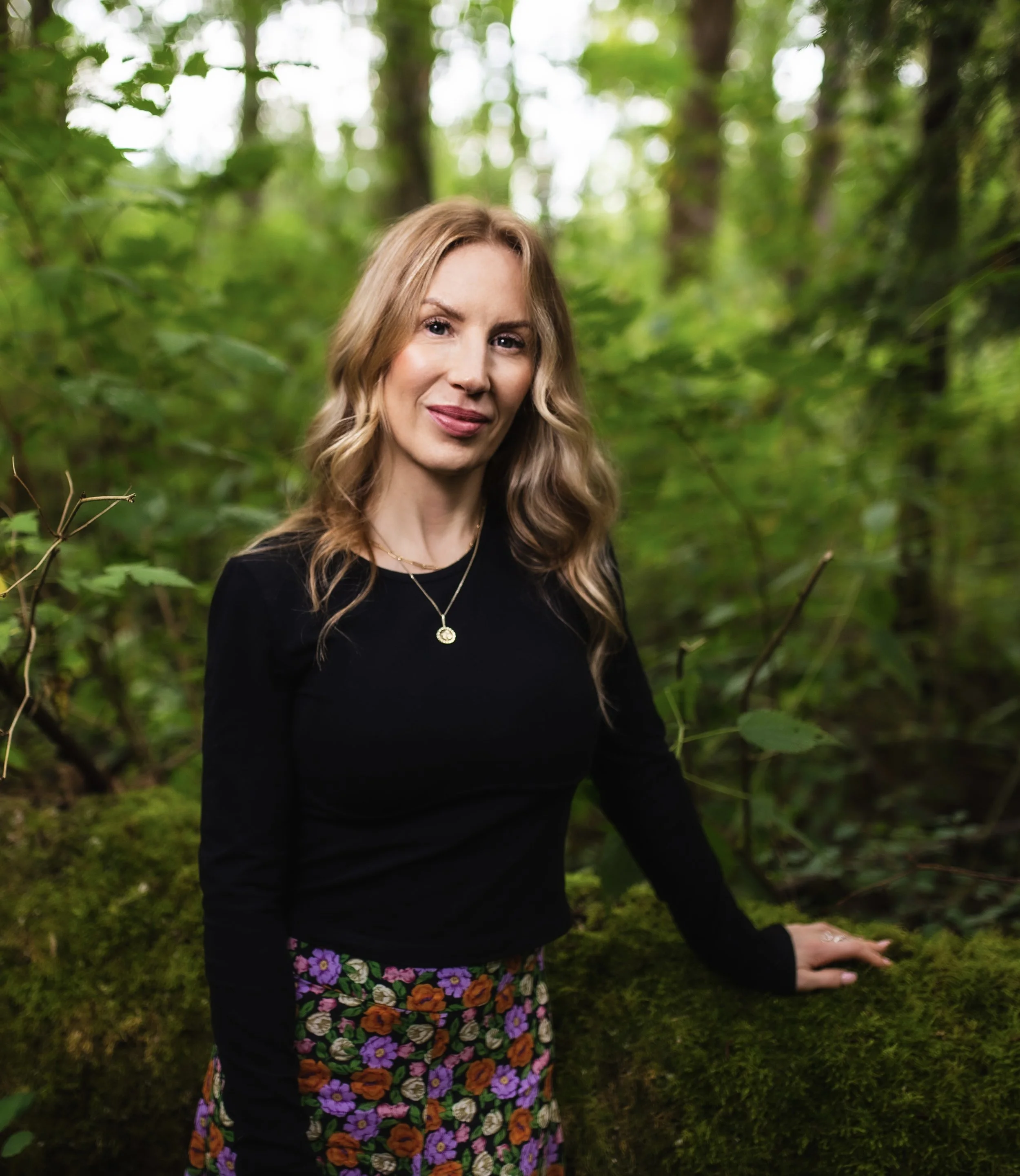
Hi, I’m Claire.
I’m a Registered Clinical Counsellor, and for the past 14 years I’ve worked with people navigating trauma, burnout, chronic stress, identity changes, neurodivergence, chronic illness, motherhood, grief, and major life transitions.
My approach has been shaped by thousands of hours of direct client work, extensive mentorship and clinical supervision, formal training, experiential learning, and my own lived experience.
I work primarily online with clients across Canada.
That means we are not limited by geography, but it also means I’m intentional about how online therapy is set up.
For the kind of work I do, a video session is not simply a phone call with a therapist.
We are creating a space where you can slow down enough to notice your emotions, body, nervous system, and inner experience. That requires privacy, comfort, and enough physical safety to settle into the work.
What Therapy Looks Like
Our work together is less about fixing you and more about understanding what your mind and body have learned to do.
Many of the patterns people want to change originally developed for good reasons.
The part of you that overthinks may be trying to prevent mistakes.
The part that keeps everyone happy may be protecting you from conflict or rejection.
The part that shuts down may have learned that feeling less was safer.
The part that pushes through exhaustion may believe everything will fall apart if you stop.
Instead of immediately trying to get rid of those responses, we get curious about them.
What are they protecting?
When did they learn to do this?
What do they need now?
And what might become possible if they no longer had to work so hard?
Depending on what you need, our work may include IFS Therapy, somatic therapy, trauma-focused approaches, Mindful Self-Compassion, Observed Experiential Integration, Lifespan Integration, and other relational approaches.
The modality is never the point.
It is simply a way of helping you get closer to yourself.


What Is IFS Therapy?
Internal Family Systems Therapy, usually called IFS, starts from the idea that we all have different “parts.”
You may recognize parts of yourself that feel anxious, perfectionistic, angry, shut down, over-responsible, self-critical, or constantly alert.
Other parts may carry grief, fear, shame, or experiences that never felt fully resolved.
Rather than treating those parts as problems, IFS Therapy helps us understand what they are trying to do for you.
A critical part may be trying to protect you from failure.
A people-pleasing part may be trying to prevent rejection.
An overworking part may believe rest is dangerous.
A numb or disconnected part may be protecting you from emotions that once felt too overwhelming.
IFS helps us build a more compassionate relationship with those responses instead of fighting them.
Over time, this can create more space for what IFS calls Self, the grounded, curious, compassionate part of you that can respond rather than simply react.
I have worked with parts-based approaches for 14 years through ongoing mentorship, supervision, direct client work, and formal training influenced by Richard Schwartz, John and Helen Watkins, Robert Falconer, Roots to Thrive, Vancouver Island University’s Psychedelic-Assisted Therapy Graduate Certificate, and my MA in Counselling Psychology.
This Might Be a Good Fit If...

My work tends to fit clients who are ready for something more reflective than advice or quick coping strategies.
You may have already done some therapy or personal growth work.
You may understand yourself quite well intellectually but want to develop a deeper relationship with your emotions, body, and nervous system.
You may be ready to:
Slow down instead of immediately solving
Stay with difficult emotions a little longer
Notice what is happening in your body
Explore protective patterns without judging yourself
Question expectations that are no longer sustainable
Set boundaries that may change relationships
Trust your own inner authority more deeply
Make meaningful changes in work, relationships, or lifestyle
Become more comfortable with uncertainty
Build a life that requires less constant overriding of yourself
You do not need to be in crisis to deserve therapy.
In fact, my practice is best suited to people experiencing mild-to-moderate concerns who have enough stability in daily life to engage in reflective, depth-oriented work.
It is not designed for acute crisis stabilization or intensive mental health care.
Most of my counselling practice is online.
I’m based in Langley, British Columbia and work virtually with clients across Canada where my professional scope permits.
Online therapy means you can choose a counsellor based on fit rather than simply who happens to practise nearby.
It can also remove barriers related to commuting, mobility, caregiving schedules, health, or geography.
My very limited in-person availability is reserved primarily for Psychedelic-Assisted Therapy, so general counselling, IFS Therapy, somatic therapy, and trauma-focused work are offered primarily online.
Online Therapy Across Canada
Frequently Asked Questions
-
Yes.
IFS Therapy translates very well to online sessions because much of the work involves slowing down, noticing your internal experience, and becoming curious about different parts of yourself.
Having a comfortable and pri
-
Yes.
Somatic therapy does not require a therapist to physically touch or manipulate your body.
We may notice posture, breath, tension, movement, sensation, activation, or what helps you feel more grounded.
Because your physical environment plays an important role, I ask clients to attend from a comfortable, private space where they can sit or lie down and move if needed.
-
A parked car may occasionally be the only private option available, but it is generally not ideal for the deeper somatic and trauma work I offer.
A comfortable indoor space where your body can relax and you will not be interrupted is preferable whenever possible.
Sessions cannot take place while driving.
-
For general check-in conversations, occasional interruptions may be manageable.
For IFS, trauma, and somatic therapy, I strongly recommend arranging for someone else to care for children during the session whenever possible.
You need enough privacy and attention to stay connected to your own experience rather than remaining in caregiving mode.
-
No.
IFS is one of the primary modalities that informs my work, but I also draw extensively from somatic therapy, trauma-focused approaches, Mindful Self-Compassion, Observed Experiential Integration, Lifespan Integration, and other relational approaches.
Therapy is adapted to the person in front of me rather than organized around one model.
-
Many extended health plans cover online sessions with a Registered Clinical Counsellor.
Coverage varies by plan, so it is worth confirming directly with your provider. Receipts are provided after paid sessions.description
Counselling Rates
Online Counselling
Available for clients across Canada.
Sessions are typically scheduled weekly or every two weeks depending on your needs, capacity, and goals.
50 minutes | $200
Free Video Consultation
A 20-minute conversation to get a feel for one another.
You can tell me a little about what has been bringing you to therapy, ask whatever questions you have, and decide whether my style feels like a fit.
20 minutes | Free
Sometimes we know exactly why we are the way we are. What changes things is having a different experience. Being able to slow down without something falling apart. Feeling an emotion without having to immediately escape it. Listening to your body instead of overriding it. Setting a boundary and discovering you can survive someone else’s disappointment. Meeting the parts of yourself you once judged and realizing they were trying to protect you.
That is the kind of work we can begin together.